Sunday, June 17, 2018

The Far Horizon

[Editor's Post]

Our segment this time is from our own book reviewer: D. Vour, Gourmand and Food Critic at “The Home“.

There's always something going on at The Home and in this entry "books and food" are the topic of the day.
“In The Devil's Garden” Review and Commentary by D. Vour Part 1 of 4
[Editor's note: This story was written by DVour]
Friday, March 17, 2017

Re-read our previous spotlighted item here:
Elbert
[Editor's note: This story was written by MrsB]
Friday, June 17, 2005


Friday, June 01, 2018

baseball vocabulary

I watch the Astros baseball games on TV.  I have liked the game since childhood,and remember hearing radio broadcasts of games thru open windows as I rode a tricycle on the sidewalk past neighboring houses. The other evening I began taking notice of the way the game announcer talked about the action on the field including stats about the individual players and teams.  I started writing down some of the words that belong to baseball 'lingo'.  I'm sure I missed a few, but here are words I heard during one game. 

plate, mound, curve, slider, streak, walk, bottom, lead, zone, top, hit, series, foul, pitch, outside, retired, count, alive, swing, miss, loaded, base, homer, urns, strike, season, breaking, round, score, catch, spin, stats, trade, tag, error, steal, double, triple, play, slump, single, tie, safe, wild, position, half, starters, sinker, bullpen, hook, grounded, delivery, throw, bench, stole, down, face, fly, borderline, away, relief, line, center, field, dugout, hill, deck corner, out, runners, popped

Tuesday, May 29, 2018

Memorial Day

I began my day watching and listening to speeches at Arlington Cemetery.  The guards that stand 24/7 was mentioned and I thought of a family friend who had been a guard at Arlington during his period of service. He told us about the routines and preciseness of each step in their rotations. 

Memorial Day always brings memories of wars we've had and yesterday, as I watched a special PBS documentary on the American cemeteries around the world I was once again reminded of how far afield we have sent men and women to wage war. 

And we continue sending troops to countries with names I haven't learned to spell.  We humans must have a killing gene.  If we aren't killing other humans, we kill wild animals, tigers, rhinos, elephants. 

Saturday, May 26, 2018

Metadata Isn't Metamucil by KimB

[Editor's Post]
Metadata isn't Metamucil but it often has the same run-on effect....

What the heck IS metadata and where do I find it?

Hmmm...
Good Question

Well for starters: THEY hide it from you. That is: the metaphysical and almighty THEY.

They hide because it has .... ready for it?
  • There are NUMBERS in it.
  • There are LETTERS in it.
  • There are ARCANE and ODD and Human Undecipherable Sequences in it.
Metadata is the Sanctum Sanctorum for Computers

So of course, THEY don't what you to see it.

Because it's computer related, there is a tonnage of this sort of information layered on layer over every single aspect of the internet, the web (for those that make a distinction), programs and apps (for those that make a distinction) and nearly every single thing you do on a computer.

It's like an onion with 1,000,000,000,000,000 micro layers. There are so many micro layers I doubt there are many that know every single one of them. The NSA, GCHQ and Other State Agencies along with their in-house and out-house hackers might have a good handle on the value but I suspect even they get caught out on a few of them.

So perhaps it would be best to separate our view into two segments:
  • Internet
  • Programs
Now, for the purpose of simplifying the Not Simple At All, I'm going to irritate a lot of techy-folks by clumping things into these categories when officially they don't belong together at all. But if we start trying to analyze every single drop in the ocean we'll never get to the part where you "catch the wave".

Once you "catch the wave", you can find a lot of stuff on your own.

So, metadata isn't necessarily awful or bad. It becomes awful or worse than awful, when it gets used for something other than it's original purpose. And that's 999999% of the problems today.
Metadata and it's cohorts are being used for something other than their original purpose.

All perfectly legal; brought to you by the folks who defined RELEVANT to mean EVERYTHING.

Lamp Shade Hat Dancing

We can start with that "oh so common" image of someone, a bit more full of it than others, doing The Lamp Shade Hat Dance at a party.
Yeah... THAT one...

Computer camera "photographs" are not like the old fashioned kind that used chemicals and special treated paper to make those Kodak Moments, if you remember Kodak at all. Cameras are everywhere now, but we will focus on the one in your Not-All-That-Smart Smartphone.

Basically it's 1 2 3.
  1. You point
  2. You click (which used be called shoot)
  3. You upload

You pick a format still, video, burst or select from a bunch of others. You get this nice image or video that you then post this out on social media to your friends, hopefully omitting the boss. There are however, billions and billions of others who scrape your social media pages for just this sort of thing. A whole sub-culture devoted to collection of Lamp Shade Hat Dance images.

So, skipping over the part where this image now becomes part of your life forever more and all future bosses will see this image when you go to apply for a job because your current boss just fired you for "behavior unbecoming". Unbeknownst to you, your company had a contract with a Reputation Cleaner to scrub their corporate image squeaky clean. The Rep Cleaner scraped the offending Lamp Shade Hat Dance image from the account of a friend of a friend of a friend and sent the harvested sample to your now old-boss.

Ok so we have an image... now what?

Once you get the image onto a computer, it will be a bit easier to see something akin to metadata but isn't really metadata but metadata like. Attached to your image is something called EXIF data.

So EXIF has an awful lot of junk stuff that's part of the image. There's a lot of normal good stuff there too. Most of it, no one cares about except professionals (of all persuasions). But you have to LOOK to find it.

Find an image, any image will do and Right Click the name. You will get the famous Context Window. At the bottom is the option: Properties. Click that to open the Properties Page. So far pretty ho-hum.

Next, select the tab: Details.
OH!
Oh Yeah!
There are a lot of details. Depending on what and how you got the picture much of it maybe blank. But a bunch of other stuff may not be blank. Scroll down and take a good look.

EXIF 101
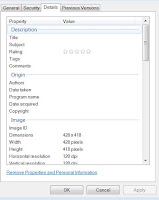
EXIF 101
EXIF 101
Congratulations! You have seen something metadata like and it follows that image forever or until someone decides to change it. Try a few more images. Get a good sample of what's there and what's not there.

So this sort of metadata isn't ugly until you start to Catch the Wave that it can be changed. In Windows you can click in any field and update the information. Clicking the Title Field will let you add a Title which isn't the same as the File Name. Clicking the Copyright lets you put in copyright information. In theory.

You don't actually have to use any of these fields for what the field name says.

Let me repeat that.

Just because a field says TITLE you don't have to put "Lamp Shade Hat Dance" in the space.

Honesty is fine, but what metadata extortionists want most from you is your GULLIBILITY. Yeppers that's really all they want. Because they expect you will be gullible enough to fill in these sorts of options Honestly and Truthfully every time. And it's not surprising, the vast majority of us do.

If you scroll down some more you might be surprised. There are some fields that you cannot alter such as those in the IMAGE subsection. Much of what's in that location relates directly to the computer representation of the image which allows the computer to display the image as it is defined in that section. Manually changing this area is blocked because the computer needs it. If the computer needs it and you want to change it, you have to use a program to do it, like Paint or Photoshop which can supply the required metadata changes as you resize or alter the image.

EXIF 102a
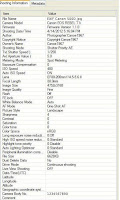
EXIF 102a
EXIF 102a
We fill out this type of information because sometimes it is of use to us. If you are a professional photographer it matters what the F-stop is or if the image used a Flash. For the vast majority of us, we tag our images differently. We don't normally stuff all images taken with Flash in a folder named /FlashPics (hmmm maybe some of us do...) . We store it by subject or use the new method of adding "tags" to stuff we do. Tags are just another onion skin of metadata.

It is likely that on the images you checked, the vast majority of these fields are blank. They aren't used at all but your image still carries this information potential everywhere it gets sent and is displayed to anyone who knows how to open the Properties Page.

Now check this list of field names and look for one that says: Geotag or Location or Latitude or Longitude or Altitude or Geographic Coordinates.

EXIF 102b

Geotagging for fun and profit
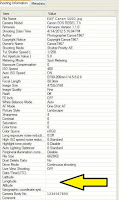
EXIF 102b
EXIF 102b
Inside most so-called smartphones are a series of components that track your position on the planet (GPS) and also track the position of your body, hand, eyes (motion and eye movement detectors), there are some that monitor if you are in couch-potato mode, doing a Px90 workout or running a marathon (accelerometers). There are microphones so sensitive they can hear your heart beating. They can also hear the heart beats of others near you. Some of these microphones can hear through walls listening and recording just in case you decide you need an immediate delivery of toilet paper by drone drop.

All of these systems are marketed as "helpful". All of them have metadata components too.

GPS is the best known of them.

Smartphones by default add GPS data to everything. If you have LOCATON SERVICES: ON then you get GPS metadata added to every photograph. This is also marketed as being "helpful".

Perhaps the manufacturers think that when you eventually get dementia after binge watching every mega costume drama made, having a geotag on an image will jog your memory of some real life event. There are lot of other people interested in where you go, when, how and what you do at that location. When you combine it with the ability to tell if your hands are moving or if your heart is still beating, this makes a powerful combination.

Some people turn off this feature. If they turn it off then, in theory, no geotags should be found on an image at the time the image was taken. This may or may not be true. Having a visibly blank data field is not the same as knowing there is no data hidden and embedded elsewhere.

The importance of geotags is so great, Google and Facebook are working with the US Government to put geotags on every image in their respective archives that doesn't have one. Because all those vacation pictures you uploaded now belong to FB and Google, they can do with their electronic image whatever they want.

They can do that to my pictures?

Yes. Because, you gave it to them.


So the current plan is to overlay all the matching geotags, the world is after all somewhat finite; using your pictures plus Sat-Intel to map out the detailed landscape at every location. Trees, shrubs, buildings, and all the finer details you captured in your vacation images plus the gross level image of Sat-Intel.

Next using the composite view, they will scan all non-geotagged images belonging to FB, Google and the NSA+chums matching up the details from their composite to what is in the image. Based on this they will assign them a geotags.

You may not be able to see the Geo Tag Property with a simple program or see all the kinds of data associated with high end devices. An advanced EXIF editor is needed.

At the bottom is the option: REMOVE PROPERTIES and PERSONAL INFORMATION

Clicking this brings up another page where you can erase some or all of the displayed data. It does not necessarily remove ALL optional data and it may or may not remove the HIDDEN data. Which brings up another problem with metadata.

Metadata definitions change all the time. New ones are added and old ones either removed or repurposed. The ability of any program to display or edit metadata depends on what versions of metadata the program recognizes. Programs might not display geo-coordinates simply because those fields were not there when it was created. The program displays what it can but you will never know if there is more there that is not displayed unless you start metadata hunting or acquire a program that handles more metadata types.

There are similar tag fields on audio files. iTunes has a pretty good field editor but in early days as the number of fields increased, iTunes didn't support changes to all the new fields. I used a third party external programs to change the fields. I could tag multiple files at one time and do mass updates. Just because iTunes didn't display them other devices did.

So, here's the rhetorical question:
If there isn't anything harmful in metadata why is there an option to delete it?

Because there is harmful stuff in metadata and there are plenty of people looking for it. Your Lamp Shade Hat Dance cost you your job and may prevent you from ever getting another one. That's a pretty harmful and drastic result.

Now to extend our discussion some, the metadata you see via EXIF editors is not all the metadata there is.

Are you shocked?
I hope not.

Embedded directly IN the image is more metadata. This data is not accessible to the average shmoe. It takes some serious geeking to see it. You need a hex editor at the very least and an in depth knowledge of how a computer stores images. Along with these you will find more sub-sub-sub levels of metadata.

EXIF 103

EXIF 103
EXIF 103


An example: There is an audit log of file changes to the image. This is called the UNDO list but really it's just a log of who changed what when where with more metadata than what you've been looking at. Yet another onion level. Metadata can be useful in a number of ways. When you upload an image portions of the metadata can be used by the web service to better display the image. Some of it maybe helpful in finding your image in a photo archive. By now, you probably have figured out that the archive itself adds metadata identifiers to your image too.

EXIF 104

EXIF 104
EXIF 104

Adding in "identifiers" is how Google, Facebook along with all other internet related businesses like ATT, Comcast and others keep track of YOU. There are special law enforcement groups specifically tasked with adding and hiding metadata IDs in certain types of pictures to track people of interest to them. These pictures, if found on your computer, can send you to prison for a very long time. Metadata tracks how they got to your computer - maybe.

Even professionals get surprised about what metadata shows about their work.

Going to a war zone is dangerous - period. Going to a war zone to take pictures and video is really dangerous - as the deaths of documentary journalists can attest.

A few years back, a well known photo journalist took an outstanding image in combat. It was extraordinary. A major news outlet carried the image and the stories associated with it. Then metadata happened. The news outlet fired the photo journalist. Not because the stories were false but because the photographer had photoshopped the image. The news outlet said that it only buys un-doctored images and this was a violation of their policy.

The news outlet did not relate how they discovered or verified the alteration but within each image are levels of details that even the professionals have a hard time tracking. Soon enough the True Original and the Altered Image were on display. The bottom left corner of the image had been over-written by a photo editing program to stamp out a camera bag that was in the frame. This photo stamping overwrites the selected area with another portion of the picture. In this case the photo journalist had stamped out the camera bag matching that area to the rest of the terrain.

There was a lot of sputtering and stuttering as journalists and photographers debated the de-merits of the offense. For an odd reason the consensus was if the photographer had CROPPED the image to exclude the bag that was OK but because he had cropped the camera bag by STAMPING it, this was not.

This image's legacy is the same as the Lamp Shade Hat Dance image.
Metadata doesn't go away.

Which brings us back to the beginning.

Metadata is not bad. It gets badly used. It tracks changes that otherwise would never be noticed. There is no way to remove it completely. You have little control over what's there. You have no input into what's added or excluded. You have no control over who gets it or what they do with it but that's not the end.

Special technologies now allow for the editing of images, documents, pdfs, voice and media without leaving the required metadata finger prints.

That's right.

Someone can now photoshop "anyone or anything" dancing with that lamp shade next to the offending camera bag and no one can ever tell that this wasn't a real image. It cannot be detected as a fake in any way.

If metadata provides an audit trail of what you do and where you go and who you hang around with, and allows us to tag images with useful information then what is the purpose of invisible metadata?

Invisible metadata is not the same as Omitted metadata. Omitted metadata is just blank. Invisible metadata happens outside of normal metadata. Invisible metadata by-passes everything. It's a method of forging information into an image, document, video, audio or other metadata related system - which means everything on the internet.

The advent of these metadata forgeries will have a profound effect on everything.
  • There are people who openly Share Metadata
  • There are lives that depend on Omitting Metadata
  • There are those who actively Falsify Metadata
  • There are careers incumbent on Invisible Metadata

The majority of people know that metadata is what we use "to kill people"; metadata is "Warheads on Foreheads" and viewed as the perfect tracking system; getting more sophisticated at each iteration. But if metadata can be forged leaving a fake audit trail; if metadata can obliterate and invisibly alter every component that relies on metadata then the diversion of metadata for other purposes becomes an unreliable practice.

Using metadata outside it's Original Purpose becomes even more hazardous than a Lamp Shade Hat Dance with a Camouflaged Camera Bag.

The first part of catching a wave is knowing how to find the ocean.


Wednesday, May 23, 2018

The Far Horizon

[Editor's Post]

Our family has so many great stories to share!!

The month it is a fantastic memory of MrsB's brother: Elbert which she finishes with a "noble shining" poem fit for any king.
Elbert
[Editor's note: This story was written by MrsB]
Friday, June 17, 2005

If you missed our last entry, no worries! You can re-read and enjoy the article again here:
Flying Saucers by Loretta
[Editor's Note: This story was written by Loretta]
Friday, October 15, 2010


Tuesday, May 22, 2018

Showers and Flowers

This merry month of May is crowded with days I celebrate. My brother Charles' birthday on May 16th , and the folks wedding anniversary, May 19th, plus Mother's Day on the 13th. Memorial Day is on the 28th. The Royal wedding took place on the same date as Mom and Dad's anniversary so I celebrated both. I watched the Royal wedding from start to finish, then later in the day, I celebrated with two big helpings of my favorite carrot cake with cream cheese frosting.

The days have been lovely. Flowers blooming in all the flower beds. One bed has several six and seven foot stalks of sunflowers with huge yellow blossoms and one stalk taller that has yet to bloom. It's our first time planting sunflowers so we are surprised at how tall they grow. The famous paintings of sunflowers don't give much of a hint of the height they can reach.

We've picked a few green beans from the plants climbing the string trellis. While chatting about the garden with my son, I told him about my earning money picking green beans when I was around 13 or 14.

During the summer when school was out, the word would circulate thru the neighborhood that anyone interested, could earn a penny a pound picking green beans. A farmer would drive a truck down our street and pick up kids waiting for him, and take them out to the country where the bean fields were. We would get a big gunny sack to put the beans in and drag it along as we picked down the row. We crawled on our knees down the long rows, and when the sack got pretty full, we'd take it to be weighed. We could all see how much the sacks weighed so there was never an argument about how much one earned. One of my girl friends and I competed on how much we could earn during that day. We took sack lunches with us and when noon came the farmer blew a whistle, but it was up to each kid to decide how hard or how long to work. The only thing was, you had to stay until the farmer said it was quitting time, and then he'd take us back to where he'd picked us up. We were all home again by the time supper time rolled around.


Saturday, May 12, 2018

Time

I time myself to see how long it takes me to knit a row on my Saxon Braid afghan. While doing so, I often think of the Hawkings' book, 'The Brief History of Time' That doesn't make me knit faster or slower, but I sometimes play a game about the word, Time. It's just a mental exercise I indulge in about the things we do with the word Time.

TIME
Things you can do with it Things you can't do with it
use it stop it
waste it relive it
give it inherit it
take it see it
calculate it hold it
record it stir it
plan it drag it
recall it draw or paint it
check it delay it
forget it dispense with it
miss judge it
change it
save it
lose it


I'm sure there are other words, like 'disperse' that could be added to the count but this game is not for writing down, only for thinking while knitting and/or losing a chess game on Time.

Saturday, May 05, 2018

Derby day

The run for the roses is the most exciting two minutes in horse racing.  The closest I ever got to the famous race was when the family visited Churchill Downs one year when we visited grandparents in Louisville during Dad's three week annual vacation.  Back in those childhood days, touring the race track only meant seeing beautiful horses and hearing comments about them. 

As years passed, I understood the importance of the race and that it was the first of three races to determine the winner of the Triple Crown.  As I watch the pre-race hoopla on TV, I try to pick one of the horses on parade that I think will win.  Of course I take note of the hats the women wear, and check the colors the famous jockeys are wearing.  When the band plays My Old Kentucky Home and the TV cameras pan the spectators singing the song, my heart skips a beat because that's my song, having been born in Louisville.

Tradition has it that the race has an official drink, the Mint Julep.  That and the famous blanket of roses that's put on the winning horse as soon as the race is over.  Some of the winning horses have become legends and stories told about them for years.  Perhaps todays winner will become one of those unforgettable horses that we will remember for years.
   

Sunday, April 22, 2018

Art History

I enjoyed watching the PBS program Civilizations.  The drawings and paintings of the many generations of humans is truly a history of how we lived thru the ages.  From the cave drawings to contemporary paintings we see how humans created societies that led to a greater understanding of the world around us.

We take so many things for granted that we forget that these discoveries happened when someone had a moment of curiosity and the insight to a new understanding.  We all marvel at the discoveries, many of which are built on previous ones, which in turn, lead to new ones.  

Whenever I look at a picture of the cave drawing of a hand, I'm struck by the fact that its the very first time a human made an effort to represent something in a drawing.  Of course hand prints and foot prints were familiar sights, but the impetus to trace one's hand and fingers, then to see the tracing on the cave wall, must have been a mind boggling moment!

Monday, April 16, 2018

Saturday, April 14, 2018

Blog Stats for Fun by KimB

[Editor's Post]

With every website and every webpage and every web interaction a host load of data is collected. This data is separate from the intimate details Facebook and Social Media collect but it's part and parcel of the kind of data Google specializes in. Not all data collected is harmful and sometimes it's interesting, in a curious sort of way, to see what the data shows.

Sort of like looking at cheese under a microscope.

Data is data and statistics are statistics and occasionally they may be correct but then maybe they aren't. Because rarely does anyone other than academics reveal how they Got The Answer. So the answers here are for fun and curiosity. 1

  • There are 233 locations on the globe that have been marked as visiting the blog.
  • More than 1,400 pages viewed monthly.

Top 10 Countries visiting the blog
  1. United States
  2. United Kingdom
  3. Canada
  4. Germany
  5. Brazil
  6. Australia
  7. France
  8. Italy
  9. Mexico
  10. Russian Federation
The blog is most popular in
  • California
  • Washington State
  • Utah
  • Arizona
  • Texas
  • Louisiana
  • Illinois
  • Georgia
  • Ohio
  • New York
The blog is least popular in
  • Nevada
  • North Dakota
  • South Dakota
  • Nebraska
  • Arkansas
  • Mississippi
  • Illinois
  • Connecticut
  • Rhode Island
  • New Hampshire
What meta-data says about people is way more than what people say about themselves. This is why meta-data is so powerful.

You might be telling "white lies" to yourself, your family or your boss, but the meta-data says different. And "there's the rub" 2 because meta-data DOES LIE. It just lies differently than people do.

There is no meta-data that is 100% truthful or foolproof.
Why?
You might very well ask...
Because, every programmer knows: Fools are extremely inventive.

And then there are those who are Not Fools but only plan to Fool You.

And now, go open your favorite Social Media App ....


References
  1. Information dated 03/29/2018
  2. The Tragedy of Hamlet, Prince of Denmark
    Act III
    To sleep, perchance to dream: — ay, there's the rub;
    For in that sleep of death what dreams may come,

    https://en.wikiquote.org/wiki/Hamlet

Wednesday, April 11, 2018

The Far Horizon

[Editor's Post]

This month's posting is a great posting by Loretta. A reminder that families are what they are, and our most prize possessions are often those that get left behind. Originally published Friday, October 15, 2010.

You can re-read and enjoy this article again here:
Flying Saucers by Loretta
[Editor's Note: This story was written by Loretta]
Friday, October 15, 2010

Monday, April 09, 2018

Monday, April 02, 2018

Saturday, March 31, 2018

A thing about Easter eggs by KimB

I remember the fun of making colored eggs. Mom would get all the paraphernalia out and would hard boil a dozen eggs. There was a wire egg holder and different glasses to hold the various colors. A mysterious wax colorless crayon was often employed to make interesting designs on the eggs. I remember the smell of vinegar too. I think it was used to activate the colors but it may have had another use .. like making deviled eggs at the same time.

My brother and I would crowd around Mom as she supervised the dunking and re-dunking of eggs. My brother was able to put the eggs in the wire dipper and dunk them himself but Mom did the dunking for me. She would dunk as I directed into each color, rotating the eggs so the colors overlapped.

I never associated the colored eggs with anything other than a mysterious milk chocolate bunny in a pretty carton showed up around the same time.

Sometimes we would go to the Museum of Science to watch the baby chicks hatch in their giant display incubator. It was always near the front lobby and was always a first stop whenever we went to that museum.

Other times we would have a picnic in the gardens there. We would find a shady spot and Mom would lay out a blanket on the grass and we would have a grand time eating the surprises she packed for us. When my brother got a bit older, he started playing musical instruments and he would bring a banjo or guitar to the park and we spent the warm spring afternoon singing folks songs. We had no problems singing the same song over and over until we got it "just right".

As I got older sometimes our picnic would be at Griffith Park. There were huge trees and the 3 of us would fan out to sketch them. We each had a sketch book and selection of pencils and off we would go, but not too far, to sketch the trees and limbs. While we were sketching Mom would get the briquette hibachi grill heating up. 1

When the grill was hot, Mom would cook pancakes with warm syrup and scrambled eggs with toast on the grill. Then we would show off our drawings. Full of food we would all take a nap on the blankets she brought and spread out on the grass under the trees.

One of my friends is making colored eggs with her grandchildren. I remarked about all the different styles of colored eggs that mark this part of the year: Easter.

When I lived in Silicon Valley, friend would to bring me one of the special eggs from the Eastern Orthodox Church in San Francisco. She explained that no one really had time to make the intricate designs and so special decorated wrappers were placed around the egg instead.

There are the fabulous Fabergé eggs. 2 50 Imperial Easter Eggs were commissioned for the Tsar and his family of which 43 still exist. Another 15 sets of eggs were commissioned from Fabergé workshop. In all 65 eggs were created and 57 survive.

The Gatchina Palace Imperial Easter Egg
The Gatchina Palace Imperial Easter Egg 3
The Gatchina Palace Imperial Egg Opened
The Gatchina Palace Imperial Egg Opened 3

I remember making a papier-mâché Easter egg. It those ancient times, we had Art Class in school. I remember we all got a balloon and the teacher puffed all of them up for us. Then we layered news print strips dredged in a flour and water paste over the balloon. Once the paper wrapper had dried, the teacher popped the balloon, leaving an empty shell that resembled an egg. The remaining weeks were devoted to painting the interior and exterior of the shell. Lastly, we made colored grass by shredding colored paper and placed this inside the painted egg. I don't really remember what it was we put inside but I remember we put something inside on the colored grass and then the teacher sealed the opening with clear cellophane as a window.

Thinking of all the different ways egg shells get decorated, I checked in at my favorite deli and asked if they had the "decals" for the eggs. They explained they don't use decals but have pre-printed sleeves with various images that you separate and put over the egg. Then you immerse the egg in hot water. Modern meets Ancient.


Shrink Wrapped Easter Eggs
Shrink Wrapped Easter Eggs4


References
  1. The traditional Japanese hibachi is a heating device and not usually used for cooking. In English, however, "hibachi" often refers to small cooking grills typically made of aluminum or cast iron, with the latter generally being of a higher quality. Owing to their small size, hibachi grills are popular as a form of portable barbecue. They resemble traditional, Japanese, charcoal-heated cooking utensils called shichirin.
    https://en.wikipedia.org/wiki/Hibachi
    https://en.wikipedia.org/wiki/Shichirin
    https://en.wikipedia.org/wiki/Brazier
    https://en.wikipedia.org/wiki/Briquette

  2. The House of Fabergé made 65 easter eggs. 50 of these were Imperial Eggs created for the Russian Tsars Alexander III and Nicholas II. Virtually all were manufactured under the supervision of Peter Carl Fabergé between 1885 and 1917.
    https://en.wikipedia.org/wiki/Fabergé egg

  3. The Gatchina Palace egg is a jewelled, enameled Easter egg made under the supervision of the Russian jeweler Peter Carl Fabergé in 1901, for Nicholas II of Russia. Nicholas II presented it to his mother, the Dowager Empress Maria Feodorovna, at Easter in 1901. The egg opens to reveal a surprise miniature gold replica of the palace at Gatchina.
    https://en.wikipedia.org/wiki/Gatchina Palace (Fabergé egg)

  4. Cut out one of the selections from the Easter Egg Decoration Sleeve. Slip this over the hard boiled egg. Dip in very hot water. The plastic sleeve will shrink wrap about the egg in a few seconds.

Project Updates

Knitting:
The afghan with a Saxon Braid is looking good. I have to pay close attention to each of the 24 stitch sequences of each of the 16 row repeats, but as I progress, its getting easier. I had to backtrack so many times due to errors, that now I just take a deep breath and concentrate on counting. I have everyone trained not to chat with me while I'm working on this blue afghan. Usually I can chat and gossip when knitting, but this project requires my full attention.

Gardening:
The Kentucky Wonder beans and cucumber plantlets are now big enough to start climbing the strings attached to the top of the wooden fence. The hibiscus plant called Confederate Rose is still in the planter pot from the garden center. We haven't decided just where to plant it. It will be a focal point with its showy flowers and we don't know if we want it in the front of the house so those passing on the street can enjoy seeing it, or if we want it in the back yard to admire while we sit poolside.

Current Reading:
I'm reading a copy of the 9th printing of ISBN 0-8165-0401-6 LC#73-101103 Recollection of a Warm Springs Apache. James Kaywaykla, a Warm Spring Apache, tells the history of the Mescalero Apaches during his childhood and the warpath years of 1800s to 1886 when they were shipped to Florida. The story is about the lives of the women and children and the great chiefs as they fought to keep their freedom from confines of reservations.


Wednesday, March 28, 2018

What DO Facebook and Google know?

[Editor's Post]

The HOT news of the moment is the "surprise!" discovery of what "private" corporations store about us. It's not "new news" its just that someone "woke up" and looked.

Such "looking" has been done in the past but has been swept away quickly. This time there is a bit of momentum and more people are "looking". It's a bit like discovering your Credit Score and checking in to make sure nothing is too horribly wrong.

The following 2 articles are pretty good and one has an excellent description of how to check what's out there. What is worth remembering is that this is just a portion of the data held by Facebook and Google. Similar data is held by every company you have ever dealt with on-line or who has a computerized interface. Corporations used to purge old information but these days, they rarely purge because even after you're dead, the data helps them target people around you and your surviving family and friends. This goes forever.

There is an aspect of the data that is "stagnant" and another that is "active". Letting "active data" become "stagnant" is about all you can hope for. The way to do this is:
  • Remove unused or unnecessary stuff from your computer and phones
  • Don't use or download stuff you don't need
  • Drop all links to "cloud" storage or apps that "auto sync" to multiple devices
  • Take a few hours to be bored and click on every option in your phone from Top to Bottom and verify the setting is what you want or are willing to tolerate. This exercise has to be repeated on every device and every time there is an update.
  • Learn to turn on/off the DATA option on the phone/device
  • Learn to turn on/off the WIFI option on the phone/device
  • Clean out and delete old information
If you have a device that is already setup in good order with a reduced footprint, know that every time you use it it is logging data by the nano second. It isn't that you should not use such a device but rather that you be in control of the device and mindful of what is actually happening.

Beyond the settings, there is an enormous industry in the background that accumulates data from all sorts of other "public" or "permitted" or "open" systems. Anything that is Public Record is harvested. There is little or nothing you can do about these sources.

Control what you can.
Reveal what you want.
Protect those around you.

KimB Editor


References

  1. https://www.theguardian.com/technology/2018/mar/28/beware-the-smart-toaster-18-tips-for-surviving-the-surveillance-age
  2. https://www.theguardian.com/commentisfree/2018/mar/28/all-the-data-facebook-google-has-on-you-privacy


Monday, March 26, 2018

Monday, March 19, 2018

Saturday, March 17, 2018

Danny Boy

Danny Boy 1


Oh Danny boy, the pipes, the pipes are calling
From glen to glen, and down the mountain side
The summers gone, and all the flowers are dying
'tis you, 'tis you must go and I must bide.

But come ye back when summers in the meadow
Or when the valleys hushed and white with snow
'tis I'll be here in sunshine or in shadow
Oh Danny boy, oh Danny boy, I love you so.

And if you come when all the flowers are dying
And I am dead, as dead I well may be
You'll come and find the place where I am lying
And kneel and say an "Ave" there for me

And I shall hear tho' soft you tread above me
And all my dreams will warm and sweeter be
If you'll not fail to tell me that you love me
I'll simply sleep in peace until you come to me


References

1. "Danny Boy" is a ballad set to an ancient Irish melody. The words were written by English lawyer, songwriter and entertainer Frederic Edward Weatherly (1848-1929) in 1910 and usually set to the Irish tune of the "Londonderry Air".